The article will change over time as new information will be added. We plan to post more about AIMR and its activities as well as the PPP past. As much elements of this plan are complex and confusing, we may have done some mistakes, and it is advised to look at the source and to make your own researchs on the matter. Please tell us if we made any mistake or if you want to add new information.
3) AFD stating to have single handledly stopped the JAZA membership from the WAZA in march of 2015[1] :
"Our groundbreaking legal action in Switzerland argued that WAZA should stop endorsing members involved in dolphin hunting and other animal cruelty.AFD’s global petition mobilised tens of thousands of people, calling on WAZA to take action against its fee-paying members that bought dolphins captured in the bloody Taiji dolphin hunts. Our passionate supporters took to social media en masse, demanding that WAZA do its job and put animal welfare before profit.These actions had an enormous impact.Within a month, WAZA’s Japanese member was suspended.A few weeks later, in a momentous breakthrough, Japanese aquariums in the WAZA network agreed to stoppurchasing dolphins from the Taiji hunts.Our legal campaign against WAZA had never been attempted before, and it certainly paid off. As dolphins captured for the aquarium trade provide the economic incentive for the hunts, this amazing victory will save the lives of countless dolphins.As the Sydney Morning Herald reported, “A small Australian group has done what years of vigils, arrests, and even the plea of a Kennedy could not: knock the wind out of Japan's dolphin hunt.”
Notice that the Sidney Morning Herald makes no mention of Ric, Dolphin Project, the Earth Island Institute or any of the major actors in the affair from the very beginning. It seems that the AFD petition, while important, just came at the end of an already important bandwagon of organisations which fought for such an outcome since several years[2], including a petition by the Dolphin project itself [3]. Sea Shepherd contribution[4] isn't mentionned either.
More broadly, while the matter was briefly addressed on their website, financial transparency is still an ongoing problem in their case. All this should make activists prudent about where the money for a sanctuary project goes and why, and should highlight anyone about the fundamentally interested nature of sanctuaries as a whole. While they assure their prospective supporters of financial transparency, using donor money responsibly, and providing independently audited yearly financial statements, these have never been available and the link still leads to a page that states: "As a new organisation, we haven't yet published any financial statements. AFD's first statement will be published at the end of the 2014 financial year".[1]
Useful links :
https://www.facebook.com/OperationDolphinFreedom/posts/636012939896882:0
https://www.facebook.com/pg/AIMRdolphins/videos/
https://www.facebook.com/pg/AIMRdolphins/about/?ref=page_internal (it hihlight in particular links between this organisation and the WDCS, which is implicated in two other sanctuaries projects (the Whale Sanctuary Project and, previously, the collaboration with Merlin Entertainment), but also, perhaps more shockingly, with the Sea Shepherd Conservation Society.
http://www.dolphinmarinemagic.com.au/about (quick history of the dolphinariums (surprisingly honest about some issues), however we need independent sources, and I would be especially interested in what this whole “conservation” thing was and how many deaths there were in the park.)
http://dolphinembassy.blogspot.com/2008/04/dolphin-stranding-where-can-we-put.html (not independent, but tells a bit of early history)

A photograph of Hec Goodal at the debuts of the "Pet Porpoise Pool". We assume the dolphin held by the three individuals is "Becky", "rescued" by Goodal in the sixties.
There is unfortunately poor independent information online about the Pet Porpoise Pool and its activities. We would welcome any new information on the matter, particularly about the different cetaceans that lived in the facility and the history of transfers and deaths, but also about the alleged conservation policy of the park ; and if possible as independent and sourced as possible. [note] : The whole sanctuary operation is just one of many example in the history of human/cetacean relation showing the strong and ongoing connivence between activist organizations, scientific and conservation institutions, the captivity industry, market in general and governments when it comes to cetacean matters. Other sanctuaries projects and recent development on the matter of cetacean "liberation" well demonstrate this (such as the involvement of the trainer Jeff Foster in our global activism).
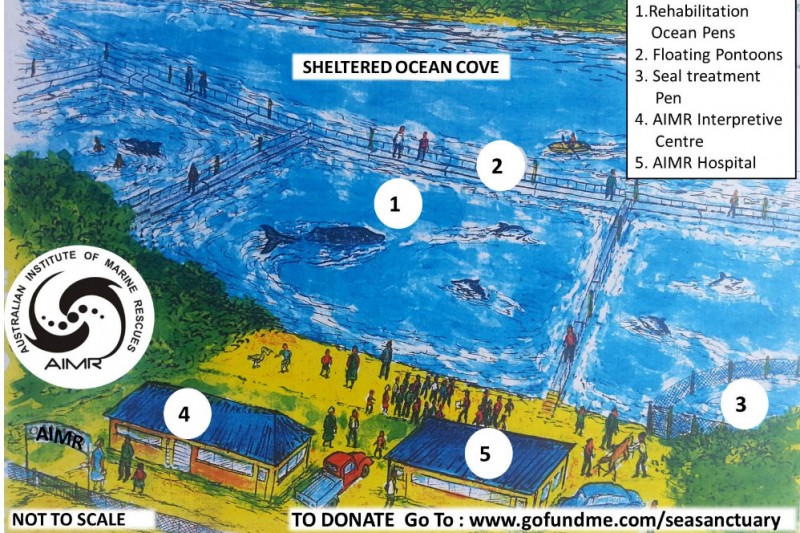
“Australia for Dolphins”, a welfare charity founded in 2012 by Sarah Lucas, an Australian citizen, proposed a sanctuary project for Australian captive dolphins in collaboration with the AIMR (Australian Institute for Marine Rescues), a local organization, aiming notably to “retire” the captives from a controversial local facility in New South Wales, Dolphin Marine Magic (previously Pet Porpoise Pool). The AIMR stated its intention to build such a project on its website as an “Aquatic Hospital” for marine wildlife, where we can read :
“Sea sanctuary and Ocean Pens: to prepare suitable animals for a soft release from ocean pens back into the ocean, as well as provide an ocean sanctuary for animals deemed not suitable for release
Animals released back into the wild after rehabilitation, will be monitored via methods such as satellite tracking, to assess the success of the rehabilitation and to add to the basic understanding of the short- and long-term movements of these animals. Suffering animals with no hope for survival will be critically evaluated and humanely euthanized if deemed necessary.”
The project is funded through a “Go Fund me” page, gathering almost 4000 dollars in a span of three months. While both official pages don’t explicitly state any will to make the facility open to visitors, let alone if entrance would be charged as a major source of funding, several publicly released articles and documents online are more informative (as well as, ironically, the GoFundMe illustration visible above) and show the prime intention of the charity is to create a visit funded based “sanctuary” established by recycling the current dolphinarium. Primarily, it is an article from May 2016 on the AFD blog section that indeed details the plan and confirms its ambition to turn it into a touristic attraction :
“The sea sanctuary could be run concurrently as an education centre, research facility and tourist attraction, providing a sustainable form of local eco-tourism to replace the failing dolphin entertainment model. This could create jobs in Coffs Harbour and bring a huge amount of tourism to the area.
“The sea sanctuary could be run concurrently as an education centre, research facility and tourist attraction, providing a sustainable form of local eco-tourism to replace the failing dolphin entertainment model. This could create jobs in Coffs Harbour and bring a huge amount of tourism to the area.
In the past six years, the park’s annual reports demonstrate profits have decreased 90% – long before Australia for Dolphins began campaigning on the issue. This is indicative of a global trend of people turning away from marine parks. It is inevitable the park will close. That’s why it is so important to create a new model, before it’s too late.”
“Based on previous sea sanctuaries built overseas [NDLR : there is no open cetacean sanctuary as we talk. It is possible that the author refers to the estimation made by Munchkin inc. on the Whale Sanctuary project, or that s/he refers to places similar in form to sanctuaries such as Dolphin Reef Eilat, Dolphin Quest or Solangi’s Dolphin Research Center], the cost of establishing a facility of this nature in Australia is estimated at $750,000. The facility would also have ongoing running costs of approximately $500,000 p/a, which would cover veterinary salaries, staff, security, maintenance and food.
“Based on previous sea sanctuaries built overseas [NDLR : there is no open cetacean sanctuary as we talk. It is possible that the author refers to the estimation made by Munchkin inc. on the Whale Sanctuary project, or that s/he refers to places similar in form to sanctuaries such as Dolphin Reef Eilat, Dolphin Quest or Solangi’s Dolphin Research Center], the cost of establishing a facility of this nature in Australia is estimated at $750,000. The facility would also have ongoing running costs of approximately $500,000 p/a, which would cover veterinary salaries, staff, security, maintenance and food.
Australia’s captive dolphin facilities currently receive sizeable grants from local and federal government. Sea World, for example, received $250,000 from the federal government in 2014 and Dolphin Marine Magic received over $300,000 between 2009 and 2014. These funds could potentially be reallocated to cover some of the construction and running costs of a sea pen facility. Australia for Dolphins and other conservation organizations would also be willing to fundraise to help with the construction of the sea sanctuary, and tourism revenue could help offset running costs.”
More direct references to this come from the facebook page (which is named after the dolphinarium, and is a page setup by activists supporting the sanctuary project, claiming to be in most part an integral part of the global effort to found the sanctuary). Stating :
More direct references to this come from the facebook page (which is named after the dolphinarium, and is a page setup by activists supporting the sanctuary project, claiming to be in most part an integral part of the global effort to found the sanctuary). Stating :
“As for tourism in Coffs Harbour: AIMR plan on building a Marine Rescue Centre and Sea Sanctuary which will be open to the public and a huge draw card attracting the right attention unlike the negative attention DMM attracts to Coffs Harbour. Hec Goodall the founder of the much loved former Pet Porpoise Pool, is planning on building a new park in Coffs Harbour. Once built the fate of Dolphin Marine Magic will be forever sealed. Their time is coming to an end.”
The catch 22 being that one of the AIMR founders, Hec Goodall, is also the very founder of the “Pet Porpoise Pool Ltd”, the company owning Dolphin Marine Magic that he himself founded and directed from 1970 to 2004. The reason for his apparent disenchantment with captivity is due to a series of internal conflicts with the current CEO of the facility, Ms. Paige Sinclair, over the current treatment of the captives by the new administration. The point though, is that even if Goodall’s claims seem more progressive than those of his colleagues on cetacean matters, he ruled no less than a dolphinarium for 34 years, with all the pain, suffering and lack of ethics that captivity and training for profit implies. The global rhetoric and support for the sanctuary is mostly welfarist in nature, claiming overall that Goodall’s handling of “his” former dolphins were ethically validated because the facility fulfilled its deed in term of rescue and release operations, conservation and pedagogy, arguments normally long dismissed by the global mainstream activism. This in fact well shows, through the sanctuary idea, that Goodall’s intention is to restore the dolphinarium to its “former glory” and tells more about internal game of power between the people in charge without showing any consideration for what the captives may feel or want, or about the very problem of cetacean ownership at all. More, the very fact that a dolphinarium owner seeks to own a sanctuary is pretty telling about the status of cetacean sanctuaries in itself.
The catch 22 being that one of the AIMR founders, Hec Goodall, is also the very founder of the “Pet Porpoise Pool Ltd”, the company owning Dolphin Marine Magic that he himself founded and directed from 1970 to 2004. The reason for his apparent disenchantment with captivity is due to a series of internal conflicts with the current CEO of the facility, Ms. Paige Sinclair, over the current treatment of the captives by the new administration. The point though, is that even if Goodall’s claims seem more progressive than those of his colleagues on cetacean matters, he ruled no less than a dolphinarium for 34 years, with all the pain, suffering and lack of ethics that captivity and training for profit implies. The global rhetoric and support for the sanctuary is mostly welfarist in nature, claiming overall that Goodall’s handling of “his” former dolphins were ethically validated because the facility fulfilled its deed in term of rescue and release operations, conservation and pedagogy, arguments normally long dismissed by the global mainstream activism. This in fact well shows, through the sanctuary idea, that Goodall’s intention is to restore the dolphinarium to its “former glory” and tells more about internal game of power between the people in charge without showing any consideration for what the captives may feel or want, or about the very problem of cetacean ownership at all. More, the very fact that a dolphinarium owner seeks to own a sanctuary is pretty telling about the status of cetacean sanctuaries in itself.
According to Goodal, his objective is to turn the previous park into a visitable seaside sanctuary more than once in the media : in at least one newspaper entry “(...) But times have changed and the park needs to evolve too. It's time we rededicate the park to marine conservation. I would like to see the facilities re-purposed into a marine hospital. I would also like to see the park's captive dolphins retired to a natural sea sanctuary where tourists could still visit them.”[1]. Similar statements were issued in a video online on the AIMR facebook page[2].
He seems in fact to be overall the main proponent of this idea, whereas both AFD and the AIMR try to avoid mentioning continued captivity in itself while indirectly supporting a backward rhetoric, even by current “mainstream” activism standards. Needless to say that one doesn’t have to be fooled by the repeated claims by Goodall that “his” version of a dolphinarium isn’t profit based (“The centre costs a lot to operate and we always intended to pay our way but not return a surplus profit, we only wanted enough to get by.”[2]), whereas Sinclair’s one would work as a deviation from the initial “respectable” model : beyond money itself, the same structures of power and exploitation are at stake, and the conflict can be boiled down to a simple battle for control over the facility by the two competing directors, activists merely working as instruments in this fight. In fact, Goodall himself clearly claims his commercial roots, despite his criticism of the following CEO to turn his “rescue and research enterprise to a profit-driven tourist attraction” : “The Pet Porpoise Pool was initially established by myself, like-minded and business people, for marine research, rehabilitation and education and was designed to be a progressive development for community benefit and to stimulate tourism,” Mr Goodall said.””[2]
A sketchy plan ?
In a parallel way, the plain, simplistic nature of the AIMR page, with poor information about them available and most importantly the fact that we couldn’t find any reported case online of a stranding rescue case this organization participated in. It seems that the organization has clearly in mind the conversion of the ex Pet Porpoise Pool dolphinarium into a seaside sanctuary, as a way to attain their objective of founding a "marine mammal hospital" (see illustration above). The AIMR, founded by Verné Dove, an awarded veterinarian and a SSCS member[1], also has a twitter account ; appart from a photograph of the founder along a mass sperm whale stranding in New South Whale in 2014 (which, despite what the tweet may suggest, Mrs. Dove has apparently no connection with : nowhere online she is mentionned in connection with the event[2][3][4]), they seem to mostly be involved in some way in the monitoring or management of free dolphin populations in the area which are in contact with local human populations[5]. (We will detail in another document our opposition to the policies and ideology behind these free populations managment by scientific and conservation agencies, which are deeply tied to the captive industry wether in facts or in ideas). We can for instance point out that Troy Saville, one of the active members of the AIMR[6] was the former manager of the Pet Porpoise Pool and a trainer, which was also involved in the monitoring of the local free tursiops populations.[note]
As for Australia for Dolphins, the charity is a particularly blatant example of a group in which research for profit leads over awareness or education. While following the classic line of our activism (mentioning cetacean intelligence, “strong familial bonds” etc.) both the website and the facebook page are designed in a way to gather money rather than to convey information. Both pages open with a clearly visible tie-in boutique and a “donate” button, while the Facebook page is riddled with posts written in angry and expletive ways reminiscent of certain minor activists with an extensive following, when appeal to emotion and culpability aren’t used to push users to donate. The online boutique sells t-shirts and other ties-in which of course exploit a ‘kitsch” and “cute” imagery of dolphins (a problem we will see in Part 7). Both groups seems to mostly address the Taiji “dolphin slaughter” as a cause to fight, while ignoring many of the other issues at hand with dolphins and the dolphinarium industry (the Solomon trade, the captures in Cuba and Russian waters…). All these easily verifiable facts are we believe symptomatic of what we understand as a profit-making bias behind the basic “dolphin activist” profile.
One can indeed wonder where exactly money for donations goes and how it is used : both the facebook page and the website are vague at best, and don’t seem to be linked to any official organization, local association or scientific institution dedicated to cetacean studies, helping stranded or fighting against Taiji (apart from the Australian organization “Voiceless” which focuses on their country’s slaughterhouses) ; Ric O’Barry’s Dolphin Project in particular never being mentioned despite their firsthand importance in the Taiji front. They seem, otherwise, to make no mention of other organization, association, institution or individuals implicated in the dolphin and Taiji matter, a particularly suspicious fact when we know that much of what they talk about is already well worked on for decades by many others outside of their tight national circle.
Overall, the charity is already controversial inside of our global activism, whether it comes to its financial transparency or its tendency to appropriate for itself the merits of a fight largely started by others before them. It is broadly suspected that many of their claims are at best dubious. In particular :
1) The alleged “release” of a captive tursiops nicknamed “Lulu” from a Salomonese seaside restaurant in 2016[1], that AFD claims to have done thanks to one of their lawyers - no solid proof (photographic and from cross witnesses reports in particular) having been released showing either that the dolphin is alive or that AFD indeed caused her liberation. It is obvious that they learned of this so-called release at the same time a anyone else: when it was announced on the Visit Solomon Islands Facebook page[2], while they claim that they have "inside information" and that "their lawyers have applied pressure" : there is little or no evidence of either the lawyers having done anything, or if so, have had results. If this were the case then obviously there in any case would not be questions asked on the Tourism page, and they would have known of developments, which was obviously not the case. More disconcertingly, they then proceeded to assure everyone that Lulu had in fact been released, based on the picture of an empty pen. There is no definitive proof that Lulu has been released : she could have died in the meantime, as well as sold or eaten. However, AFD were still asking for donations to pay for their lawyers to obtain Lulu's release at the time she was already ostensibly released ; before proceeding to thank their followers for helping them obtain her release.
2) AFD stating[1] that a lawsuit they filled (and finally won[1][2]) for the dolphin nicknamed “Angel” against the Taiji Whale Museum which could lead to this dolphin being put in a sanctuary[3], while it in fact only concerned a discrimination case against the charity CEO. This point was addressed by the Dolphin Project which notably states :
1) The alleged “release” of a captive tursiops nicknamed “Lulu” from a Salomonese seaside restaurant in 2016[1], that AFD claims to have done thanks to one of their lawyers - no solid proof (photographic and from cross witnesses reports in particular) having been released showing either that the dolphin is alive or that AFD indeed caused her liberation. It is obvious that they learned of this so-called release at the same time a anyone else: when it was announced on the Visit Solomon Islands Facebook page[2], while they claim that they have "inside information" and that "their lawyers have applied pressure" : there is little or no evidence of either the lawyers having done anything, or if so, have had results. If this were the case then obviously there in any case would not be questions asked on the Tourism page, and they would have known of developments, which was obviously not the case. More disconcertingly, they then proceeded to assure everyone that Lulu had in fact been released, based on the picture of an empty pen. There is no definitive proof that Lulu has been released : she could have died in the meantime, as well as sold or eaten. However, AFD were still asking for donations to pay for their lawyers to obtain Lulu's release at the time she was already ostensibly released ; before proceeding to thank their followers for helping them obtain her release.
2) AFD stating[1] that a lawsuit they filled (and finally won[1][2]) for the dolphin nicknamed “Angel” against the Taiji Whale Museum which could lead to this dolphin being put in a sanctuary[3], while it in fact only concerned a discrimination case against the charity CEO. This point was addressed by the Dolphin Project which notably states :
“However, I felt it was necessary to clarify the nature of the lawsuit, as Dolphin Project is now being contacted by misinformed, overjoyed supporters who want to donate money to finance Angel’s rescue and transfer to a natural seapen. They think Angel is going to be rehabilitated and released back into the wild or transferred to a sanctuary because of this victorious lawsuit. None of these things are true.
Dolphin Project’s position has always remained the same: Nobody should be asking for donations for a dolphin that is not in their legal possession. Having possession is the first, crucial step in any dolphin rescue and release process (which we will study in detail in part 3, NDLR). Without possession, it would be unethical to raise money for Angel, or any other dolphin for that matter. Angel is owned by someone else. She is considered the “property” of the Taiji Whale Museum, by the Japanese government.”
3) AFD stating to have single handledly stopped the JAZA membership from the WAZA in march of 2015[1] :
"Our groundbreaking legal action in Switzerland argued that WAZA should stop endorsing members involved in dolphin hunting and other animal cruelty.AFD’s global petition mobilised tens of thousands of people, calling on WAZA to take action against its fee-paying members that bought dolphins captured in the bloody Taiji dolphin hunts. Our passionate supporters took to social media en masse, demanding that WAZA do its job and put animal welfare before profit.These actions had an enormous impact.Within a month, WAZA’s Japanese member was suspended.A few weeks later, in a momentous breakthrough, Japanese aquariums in the WAZA network agreed to stoppurchasing dolphins from the Taiji hunts.Our legal campaign against WAZA had never been attempted before, and it certainly paid off. As dolphins captured for the aquarium trade provide the economic incentive for the hunts, this amazing victory will save the lives of countless dolphins.As the Sydney Morning Herald reported, “A small Australian group has done what years of vigils, arrests, and even the plea of a Kennedy could not: knock the wind out of Japan's dolphin hunt.”
Notice that the Sidney Morning Herald makes no mention of Ric, Dolphin Project, the Earth Island Institute or any of the major actors in the affair from the very beginning. It seems that the AFD petition, while important, just came at the end of an already important bandwagon of organisations which fought for such an outcome since several years[2], including a petition by the Dolphin project itself [3]. Sea Shepherd contribution[4] isn't mentionned either.
More broadly, while the matter was briefly addressed on their website, financial transparency is still an ongoing problem in their case. All this should make activists prudent about where the money for a sanctuary project goes and why, and should highlight anyone about the fundamentally interested nature of sanctuaries as a whole. While they assure their prospective supporters of financial transparency, using donor money responsibly, and providing independently audited yearly financial statements, these have never been available and the link still leads to a page that states: "As a new organisation, we haven't yet published any financial statements. AFD's first statement will be published at the end of the 2014 financial year".[1]
Useful links :
https://www.facebook.com/OperationDolphinFreedom/posts/636012939896882:0
https://www.facebook.com/pg/AIMRdolphins/videos/
https://www.facebook.com/pg/AIMRdolphins/about/?ref=page_internal (it hihlight in particular links between this organisation and the WDCS, which is implicated in two other sanctuaries projects (the Whale Sanctuary Project and, previously, the collaboration with Merlin Entertainment), but also, perhaps more shockingly, with the Sea Shepherd Conservation Society.
http://www.dolphinmarinemagic.com.au/about (quick history of the dolphinariums (surprisingly honest about some issues), however we need independent sources, and I would be especially interested in what this whole “conservation” thing was and how many deaths there were in the park.)
http://dolphinembassy.blogspot.com/2008/04/dolphin-stranding-where-can-we-put.html (not independent, but tells a bit of early history)
A photograph of Hec Goodal at the debuts of the "Pet Porpoise Pool". We assume the dolphin held by the three individuals is "Becky", "rescued" by Goodal in the sixties.
There is unfortunately poor independent information online about the Pet Porpoise Pool and its activities. We would welcome any new information on the matter, particularly about the different cetaceans that lived in the facility and the history of transfers and deaths, but also about the alleged conservation policy of the park ; and if possible as independent and sourced as possible. [note] : The whole sanctuary operation is just one of many example in the history of human/cetacean relation showing the strong and ongoing connivence between activist organizations, scientific and conservation institutions, the captivity industry, market in general and governments when it comes to cetacean matters. Other sanctuaries projects and recent development on the matter of cetacean "liberation" well demonstrate this (such as the involvement of the trainer Jeff Foster in our global activism).
