 |
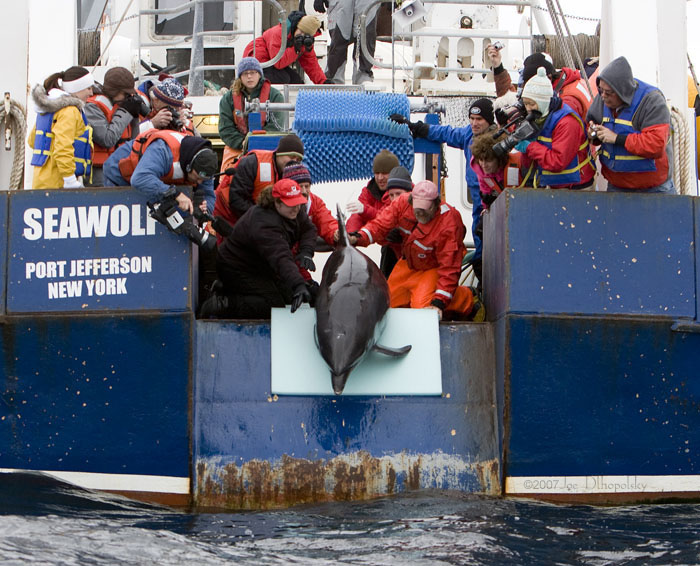
| "The first Risso's dolphin successfully rehabilitated in the United States." by the Riverhead Foundation, according to this source. |
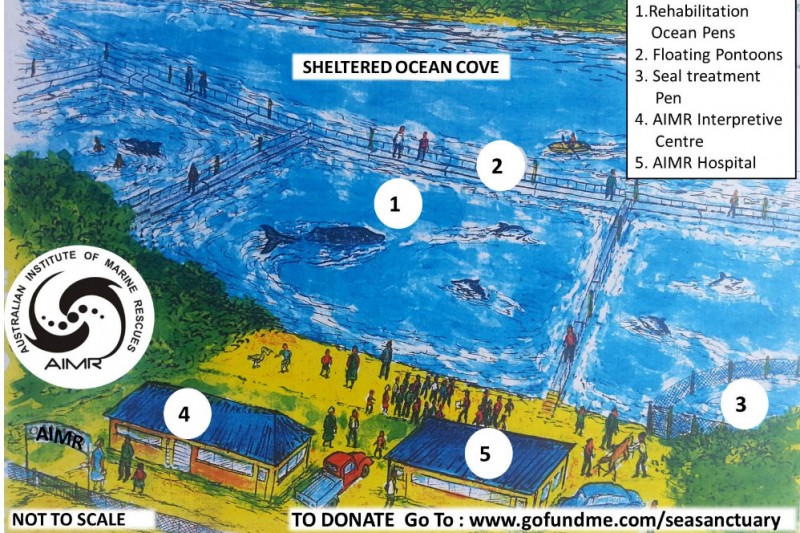
Much of our work as activists is to clarify key aspect of our opponents rhetorics in order for everybody to clearly understand the nature of our claims, beliefs and ongoing research, which as a matter of facts is far from being the case today. One of them is the typical argument that because we are anti sanctuary, anti "rehab" as it is today understood - with captivity, training and overall disrespect of captives as individuals or social members - what we really seek would be somehow to "dump" or "throw" the said captives into the "ocean" ; in other word to "condemn the captives to certain death" as it is often heard.
The obvious issue with this argument is that it is, in many, so many ways, absurd and useless ; not only inaccurately reflecting our genuine intentions but reflecting a series of common perception of the problem that seldom reflects what observable facts and analysis show.
For everyone that continues to throw us this little stupid catchphrase in hope of silencing us, that simply continue to persuade him/herself internally that this must be the outcome of captives if one was to challenge the commonly held views about the matter, or which simply strongly feel that it has to be wrong but also feel bothered and ashamed because of this "argument", this article explains why you should just stop worrying and starting to love the bomb.
I) It is invalid as an argument.
The point of the "dumping" argument isn't to bring a counterpoint to the table in order to debate an open problem and going forward in finding a consensus, but to impose by authority a set of already solidly held preconception on a matter. It isn't as such really what we would call an "argument", but rather a rhetorical catchphrase used to entice fear in most people and activists, in order to make them "join the ranks". You aren't being convinced by reason, but being by fear of the rejection and contempt of other activists and "superiors"...It should be obvious for anyone, as such, that arguments aren't neutral ; they cannot be simply reduced to a plain matter of who is right or wrong, but are to be linked to a larger structural matter of how some particular arguments are used to maintain power rather than as a tentative to emancipate the listener from its preconceptions or errors(1). As such a criticism of these very arguments cannot be separated from a broader criticism of our activism as a power structure, with its hierarchy, internals dynamics and systems to maintain the power over activists and of course cetaceans.
It would be obvious for anyone that the argument isn't meant to expose a truth but to destroy the opponent ; it isn't here to accurately describe what we seek as activists, but to highlight a spontaneous fear among most of us. As such the argument neither does accurately describe the reality of our theory and our conceptions and research - which are still an open work in progress - about "what should be done" - a formulation we will see later why it has to be severely questionned and replaced - nor indeed what happens at all when liberations occur and what phenomenons and events are at play : it isn't a genuine argument but a fantasy, as set of colorful, systemic images meant to entice fear, so nobody can question their preconceptions (and the "upper activists" practices and goals). The argument is also obviously instrumental in marginalizing the activists that dare question things as the potential "bad guys" that "want to harm the poor little dolphins by arrogance" or something similar. Our next point will be as such to briefly explain why, in a larger way, the whole idea of liberation the "dumping" fantasy root itself in has no credence in reality.
II) It describes a fantasy, not reality in any way
1. The first necessary thing is to analyze this imagery in details. This is crucial, as fear and preconceptions are in great part induced by such sudden mental images. One would in particular remark :
*The idea of "throwing" or "dumping", which implies that any liberation without the violent and oppressive act that usually characterize them - captivity, training - would be akin to a violent act of exclusion from the human sphere, understood as "safe" and "benevolent" despite its restrictive and enforcing nature, by contrast with an outside world understood as a hostile wilderness. This reasoning is of course nonsensical, as its only validity as an "anguish" or "guilt based" argument is founded on premices which are themselves faulty : not only because of a misconsideration of the cetacean psychology and the nature of oceanic environements but also and mostly because of the very nature of the "human/widlerness" divide. As we will see below, this very divide is what makes people believe in the "violent act of exclusion" in the first place ; it is paradoxically this very act which is desired by most, according to an ideology we will describe below in the document.
*The liberated being systematically imagined as "alone" or "isolated" in some kind of enormous and vast "sea" to "fend for itself". This is a constant in the usual mainstream rhetoric, which is as systemic as it contradicts much of its own discourse about cetacean being "highly social creatures" that "live in equalitarian, complex societies where everybody care for each others" and so on. Not only does it stress out the idea of the cetacean as an absolute passive victim unable to defend him/herself, sinning of paternalism as well ("the poor vulnerable little creature !"), but it betrays a larger issue of what we could awkwardly for now call the "social reality" of the last : in other words, cetaceans are always spontaneously understood as alone, isolated from a social reality or structure, instead of being understood as primarily determined by a collective surrounding him or her, which would defines its decisions and habits. At the contrary, when it comes to understand ourselves as a species, we are always understood as being inherently part of a larger social reality or structure, especially when it comes to individual relations and language but also how we deal with space and resources. Cetaceans, as for other non humans, are stripped away from this reality, instead being understood as "purely isolated objects" absolutely submitted to a hostile environment it must fend itself against ; people struggle to understand cetaceans as active producers of their own lives and as part of a larger dynamics or system they actively and consciously play a role in.
*The very idea of an "ocean" or "nature" : as discussed in more detail in our article, these notions that seem somehow intuitive and which are deeply ingrained in the way we understand other species are, in fact, extremely problematic and contrary in many ways to observation. As you probably understood at this point, the main pattern in the legitimation of such a neurotic fantasy is the belief in the existence of such a thing as "the ocean" as a "wilderness" or "nature", as a hostile, homogenous, gigantic, chaotic entity to be fought off against by "civilization" representing the western human sphere, and everything it implies (the figure of the "wild animal", the legitimation of our relation of power over non humans or other human populations, and a certain use by our societies of resources and spaces). It urgently needs to be opposed to a model derived from critical analysis, careful research and systemic observation, wether ecology which show how such system are in fact well ordered and extremely complex or a sociopolitical understanding of these spaces : we urgently need to understand oceanic spaces and environments not as "nature" but as societal spaces as we would understand our cities and countrysides.
II) It describes a fantasy, not reality in any way
 |
| Such an imagery seems to be prevalent in people's head when it comes to confronting our ideas ; a liberated dolphin outside of the practices we denounce will immediately be imagined as struggling in such a "stormy sea" where s/he would be of course "alone"... |
1. The first necessary thing is to analyze this imagery in details. This is crucial, as fear and preconceptions are in great part induced by such sudden mental images. One would in particular remark :
*The idea of "throwing" or "dumping", which implies that any liberation without the violent and oppressive act that usually characterize them - captivity, training - would be akin to a violent act of exclusion from the human sphere, understood as "safe" and "benevolent" despite its restrictive and enforcing nature, by contrast with an outside world understood as a hostile wilderness. This reasoning is of course nonsensical, as its only validity as an "anguish" or "guilt based" argument is founded on premices which are themselves faulty : not only because of a misconsideration of the cetacean psychology and the nature of oceanic environements but also and mostly because of the very nature of the "human/widlerness" divide. As we will see below, this very divide is what makes people believe in the "violent act of exclusion" in the first place ; it is paradoxically this very act which is desired by most, according to an ideology we will describe below in the document.
*The liberated being systematically imagined as "alone" or "isolated" in some kind of enormous and vast "sea" to "fend for itself". This is a constant in the usual mainstream rhetoric, which is as systemic as it contradicts much of its own discourse about cetacean being "highly social creatures" that "live in equalitarian, complex societies where everybody care for each others" and so on. Not only does it stress out the idea of the cetacean as an absolute passive victim unable to defend him/herself, sinning of paternalism as well ("the poor vulnerable little creature !"), but it betrays a larger issue of what we could awkwardly for now call the "social reality" of the last : in other words, cetaceans are always spontaneously understood as alone, isolated from a social reality or structure, instead of being understood as primarily determined by a collective surrounding him or her, which would defines its decisions and habits. At the contrary, when it comes to understand ourselves as a species, we are always understood as being inherently part of a larger social reality or structure, especially when it comes to individual relations and language but also how we deal with space and resources. Cetaceans, as for other non humans, are stripped away from this reality, instead being understood as "purely isolated objects" absolutely submitted to a hostile environment it must fend itself against ; people struggle to understand cetaceans as active producers of their own lives and as part of a larger dynamics or system they actively and consciously play a role in.
*The very idea of an "ocean" or "nature" : as discussed in more detail in our article, these notions that seem somehow intuitive and which are deeply ingrained in the way we understand other species are, in fact, extremely problematic and contrary in many ways to observation. As you probably understood at this point, the main pattern in the legitimation of such a neurotic fantasy is the belief in the existence of such a thing as "the ocean" as a "wilderness" or "nature", as a hostile, homogenous, gigantic, chaotic entity to be fought off against by "civilization" representing the western human sphere, and everything it implies (the figure of the "wild animal", the legitimation of our relation of power over non humans or other human populations, and a certain use by our societies of resources and spaces). It urgently needs to be opposed to a model derived from critical analysis, careful research and systemic observation, wether ecology which show how such system are in fact well ordered and extremely complex or a sociopolitical understanding of these spaces : we urgently need to understand oceanic spaces and environments not as "nature" but as societal spaces as we would understand our cities and countrysides.
2. The second one would be to talk of what we really mean - and seek - as a liberation process(2). One thing that should be bear in mind is how extremely difficult it is to answer most typical questions and reactions to our views on these matters, simply because most people understand the issues at hand in a totally different way than the way we do in virtue of our analysis and research. For a start, we chose not to talk in terms of "process", of "release",
Several preconceptions should be questioned, of course, starting with what we would call the "three fundamentals"(3) but one stick to us in particular, which is the recurring, extremely well rooted preconception that liberation should be understood as an exact "planned" process to be unrolled by working activists, in a way reminiscent of the construction of a bridge or some sort of engineering structure. In such a conception, no space of action is given to the liberated him/herself, which is understood as a totally passive agent to be "treated" by a process that transcend his/her existence(4). Such a conception, even if apparently intuitively sound, is obviously to be staunchly criticized, as it gives no room to the first concerned decisions or desires. The problem at the root of such a conception is of course that the question of "what should be done" with the captives is systematically hijacked by the neurotic, obsessive research of safeness by activists, which far from being rooted in genuine concerns and analysis of the situation are only here to legitimate the exploitation and ownership of the captives. In other words, there cannot be any "dumping" from our point of view because cetaceans aren't to be absolutely "handled" by a bunch of self-entitled human experts. Rather, we tend toward the idea that cetaceans should organize their own life and fight for emancipation from man's rule, with humans merely giving them the material conditions for a stable life and - most importantly perhaps - their emancipation from invasive human forces.
Several preconceptions should be questioned, of course, starting with what we would call the "three fundamentals"(3) but one stick to us in particular, which is the recurring, extremely well rooted preconception that liberation should be understood as an exact "planned" process to be unrolled by working activists, in a way reminiscent of the construction of a bridge or some sort of engineering structure. In such a conception, no space of action is given to the liberated him/herself, which is understood as a totally passive agent to be "treated" by a process that transcend his/her existence(4). Such a conception, even if apparently intuitively sound, is obviously to be staunchly criticized, as it gives no room to the first concerned decisions or desires. The problem at the root of such a conception is of course that the question of "what should be done" with the captives is systematically hijacked by the neurotic, obsessive research of safeness by activists, which far from being rooted in genuine concerns and analysis of the situation are only here to legitimate the exploitation and ownership of the captives. In other words, there cannot be any "dumping" from our point of view because cetaceans aren't to be absolutely "handled" by a bunch of self-entitled human experts. Rather, we tend toward the idea that cetaceans should organize their own life and fight for emancipation from man's rule, with humans merely giving them the material conditions for a stable life and - most importantly perhaps - their emancipation from invasive human forces.
The process of understanding "what should be done" is we claim a false problem : this isn't about "how liberation should be handled", but about ending the systemic domination of man on cetaceans, and as such the very idea that cetaceans are objects to be "handled" through a predetrmined process by a dominant human elite in the service of state or other forms of higher organizations. Of course, our sociocultural biases for power and exploitation force us in countless labyrinthine ways to understand cetaceans as passive objects to be handled and used rather than "open" actors of their own lives, which are the first entitled to decide how to organize their lives as individuals or collectives, as well as their emancipation from human forces. Humans are merely to be helpers and allies in such a process ; but at the same time, it shouldn't give us the illusion that humans should be completely separated from the cetacean reality, another way indeed to marginalize and minorize them. As people, we should, and will, naturally create bonds, work in common projects and start living lives together(5) ; but we should simply be wary of power whichever its form, and how our cultural, material, historical background push us in many ways to take profit from the other and to understand it in a way that will irremediably legitimate his or her use, exploitation and enslavement.
Other than that, we could go forward in a larger critique and re-analysis of the processes at hand, psychologically, sociologically, ethologically ; when a captive is liberated and/or subbmited to the diverses forms of training and captivity imposed by their new benevolant captors. This more empirical analysis though belongs to another article.
III) The true dumping isn't on our side...
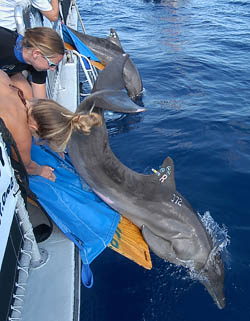 |
| "Celeste Weimer, left, and Lindsay Reynolds, release one of two rough-tooth dolphins back into the ocean off Key Largo. Photos by Andy Newman/Florida Keys News Bureau" Notice the marks made on both individuals. |
But on a larger conceptual way, both are the same thing : the cetacean is to be ideally rejected from a totally controled human sphere after a certain process of "reintegration" or "retraining", back into a supposed "wilderness" understood as a soup, before being totally forgotten ; appart of course when tracing them provides scientific datas or when it comes to "prove" that the said liberated are "fine" in this new environment, these individuals merely working as a caution for their views and practices. In other words, the very idea that cetaceans should be "dumped into the ocean" into a vast hostile wilderness is the very ideal of the one that use such a criticism against us. This is normal, since they believe in such a thing as the existence of a "wilderness", of a fundamental "human/animal" divide and so on ; it is this very belief that oceanic environements constitute a sort of hostile or idealized "wilderness" that push them to adopt such an obcessive talk about "readaptation into the wild" and all its derivatives. But far worst than this, this very ideology at the center of the notion of wilderness is that the purported "wild animals" are only defined by their own body ; they are conceived as totally cut from any relation of ownership or any tie with a broader social, political, economical or material reality. It is impossible to understand the idea of a "wilderness" defined by its chaotic and unforgiving nature without the idea of its inhabitant as a "wild animal" understood as pure objects, by contrast with (primarily the western, white male) humans supposed to hold relations of ownership, power and wealth over things.
The vast, complex issues steaming from the management of "free" cetacean populations by conservation agencies and scientists - and as such states - is of prime importance to understand the global nature of cetacean oppression and exploitation, wether on its more ideological or factual grounds. It is unfortunately mostly overlooked by activists, even if here and there some specific cases were pointed out (particularly the management of free (captures for weighing and tagging, marking, biopsies) and stranded individuals (mass euthanasias, captivity) by dolphinariums, or cases such as "Winter" from the Clearwater Marine Aquarium or "Marcos the Dolphin"). Far from being a "marginal" or fringe aspect of our "fight for cetaceans", it is in fact absolutely central to understand their plight, as it highlight the colonizing and managing aspect of our global relation with these people, but also more globally of everything constituting their social structures (the oceanic spaces, the "wildlife" that inhabit it) which needs not to be understood as a "prime natural space" but what constitutes the social, material, economical and cultural life of cetaceans.This, of course, will be the object of further investigations and reflexions from our part.
IV) ... Which leads to the true objective of our renewed fight.
 |
| Common dolphins hunting sardines. Photograph taken by Greg Lecoeur near Port Saint Johns, South Africa, on June 27, 2016. |
Liberation should be understood as a political act, even revolutionary political perspective, in sense that it needs defying and overthrowing certain specific powers in place in order to attain its objectives, and that would be the colonization of oceanic spaces and their resources by human forces. The very central sin of today's "fight for cetaceans" is that it posit itself as a typical welfare or protection activism, fueled by charity and pathos, where the fight ends when some individuals are freed, individuals which of course nobody cares about after this point. In other words, today's activism isn't political ; it is just about changing some practices (dolphinariums and other) rather than fighting the structure and dynamics underlying it ; one is supposed to plead for and to trust state for change, as well as the institutions and the very capitalist system that created the injustice in the first place after we supposedly "won" against the industry. Our point, at the contrary, is that liberation is just the starting point of a larger process of fight alongside cetaceans populations for their own emancipation from imperialistic human dynamics, wether these are captives, liberated or free, in order to help them defend their seas ("Izurdi"), or "hunting spaces" ("Jagdraums"). Liberation isn't in an case just the "release" of some individual in an hypothetical vast "ocean" understood as an abstract soup, but the act of reappropriation of cetians of their oceanic spaces they feed from and travel through. This reapprorpriation needs in any case a violent process of reject and expropriation of human competition in all its forms, and a deep reform in the way humans deal and sustain oceanic spaces and biomes.
Even the very progressive and thought provocative Ken Levasseur's third phase program couldn't think of such end, while indeed starting to think about forms of autogestion and autodeterminations of cetaceans by cetaceans of their activities and fight in the context of liberation ; it still lacks a clear political finality where the cetaceans rule and decide instead how to organize themselves when it comes to these political matters (captivity, liberation, human oppression and consequences in general), instead of humans in their generality. Keep in mind though that all this is an ongoing process of research and debate from our part, and that we're quite conscious that we are far from a truly spontaneous, intuitive equal understanding of cetaceans and other species ; our language and imagination greatly limit us when it comes to realizing how we should deal with cetaceans in general, and particularly force us into awkward formulations and lukewarm measures that clearly cannot stand as definitive solutions on the prospect.
Notes
(1) In particular, it is important to stress how certain kind of argument only appear at certain moments of a given conversation and/or of the sentence ; the dumping argument being typically used to "brush away" or to violently dismiss any criticism or doubt on the matter of sanctuaries or current efforts at "rehabilitation" of captives every time the problem is brought down during a conversation. More largely the start of a precise, systemic study of how certain given arguments appear during conversations, the sentence structure and the social context regarding these particular topics would be crucial in order to understand how people tend to be massively "floored" by certain specific forms of rhetorics (wether by opponents or simply by themselves, internally). The use of relativistic arguments (i.e "how do you know what is the best for the dolphins" "we don't know what they are really thinking" etc.) in particular comes to my mind, since they are as hypocritical and pernicious as they are effective in slowing down any questioning of common activists practices and dogmas.
To take a good illustration of this issue, one of the most solid problems we have to face is that when people tend to talk about "animal" related matters, psychology-wise in particular, they tend to "throw" ideas as if they were self-evident by themselves, e.g "since the animal has lost all its instincts"... "since its psychology was altered" "since they became too used to humans"... such preconceptions are understood as given instead of being questioned and criticized systematically. One of the first thing you must do as an activist is precisely to hold on and try to interrogate yourself about the validity of such preconceptions, even more if they resist as such and appear as solid. The other obvious response to this is to read ethological work, particularly Lorenzian classical ethology and their work and research on instinctive and innate behavior, as it helps a lot in showing a complete different reality than the "assumptions" people make on the matter. But such analysis cannot stand alone without a broader sociopolitical critique of the notion of "animal" or of such an use of science to reach our means.
(2) A project which needs to be explained in more details elsewhere as it posits in particular a more careful analysis of oceanic environments, a critical use of ethological science, a more sociopolitical or sociopsychological interpretation of how the liberated think or "behave" and why, and before as much as self analysis, self criticism and empirical, historical and sociological research as possible to see how far we can go in term of deconstructing power and building up a solid, respectful but also staunchly political alternative to what the mainstream calls "liberation" despite all our flaws and limits
(3) Obviously alongside our more general criticisms of the classical notion of "animal" as an all rounded entity to be opposed to "man" as a concept, the belief in the existence of a "wilderness" or "nature", and the common preconception about "animal behavior" and psychology, "instinct" in particular. These beliefs, obviously, not only are socioculturally determined, but were also built by our western cultures in order to legitimate the exploitation of non humans - and are possibly even instrumental in legitimating human-to-human forms exploitation and discrimination as well as a certain use of the land by centralized forms of power.
(4) The images that immediately comes to my mind would be a chicken body being processed through the conveyor belt of a factory before being covered by cellophane ; or worse, the very process of digestion where the final objective is of course the literal "dumping" of something now seen as undesirable into an abstract space to be ignored ; here the toilet boil before being flushed away, there the hypothetical "ocean" understood as some abstract unmanageable wilderness or soup ; which is of course quite ironic since the very ideology of the wilderness articulate itself with a totalitarian management of the populations and spaces deemed as "wild" by humans.
(5) Such an analysis shouldn't be understood though as a naive, "utopian" dream of some "cetacean-human community" living together in harmony in nature and so forth, a common theme of the new age imagery well incarnated by many projects such as John Lilly's work and many other of its offshoots ; at the contrary, it should be understood as a very concrete, very at-the-moment, total normalization of the relations men and cetaceans could cultivate together, beyond all our sociocultural fantasies and exoticisms, which far from being innocent constitute even the very ideological mortar of cetacean exploitation and use by humans. It must present itself as such in a very material and practical way (what could and should be done to gradually install such a "normalization" of our relations), even dare I say a Marxian one, as it is inseparable from the passage of our fight for cetaceans from a bland, conventional form of activism (which issues demands to states to regulate the work of companies and where states decide what happens ; releasing permits, moving the captives and organizing their liberation etc.) to a political one for the emancipation of the cetacean people from their colonization by men, and the reappropriation of their own bodies, workforces, oceanic spaces and resources (which would imply an opposition to states and its interests and the firsthand participation of cetaceans to their own liberations and organization).
[as a side note to this note I (A.R.) will like to explore very briefly very definition of 'utopia', why humans seek one, and why they/we basically fail to produce anything like it, despite all technological advances. It seems that for us, humans, social life matters most, but end result of this good-sounding reality - we end up re-re--re-using everything we were able to find for seemingly endless struggles for power over each other, or at least such behavior consumes most of humans who become 'more important than mass'. so-called elite, in all important spheres of life. Even if ordinary humans _might_ be less competative to the point of insanity - they also often rendered powerless, and thus seek only one working in our world solution - making themselves equally-powerful , relative to current, unjust, power holders. Most if not all humans basically fail to remain just and sensitive on this road, and this explains why it never work on social level in humans.. Anarchism as of today (2009 **) tend to blame social environment per se, in hope if we change behavior of some group of humans according to our, necessary by now, ideals/norms/values - they will produce another generations of humans who will be very unlikely to fail in old ways. I tend to disagree here, due to ethology - changes at this level happen much slower, and some naive attempt at 'making better humans via some kind of semi-self-domestication' may give strange and opposing results, or simply be reused shortsightenly by exactly those kinds of humans, who currently and in the past misused their social and technical power position. But back to utopia - why it wrong? It doesn't, if we stop confusing few things (or so I hope). We better stop to confuse 'hard' physical reality and reality of live social beings. Atoms don't give a damn about how bad you think or talk about them. Live beings, especially those tuned for group life by evolution - extremely sensitive to those kind of forces. So, social reality is softer than reality of atoms and stars - it can be changed by (dis)beliving in someone! Yet, some humans and non-humans much more sensitive to feedback from others , and this sensitive not uniform! So, while _in theory_ all humans can be changed by voice/talk/reasoning/surround behavior - in fact many never change far enough - and return to old ways of less thinking, less reflection, less reaching out intellectually and socially...Realistically, from my experience, it become harder and harder to behave in reasoned or necessary manner IF even attempts at being honest with self-descriptions and about negative sides of myself, where I greatly unsure about what is working inside me and to where it will lead me - lead to some quite negative social interactions..to put it mildly! So, this realistic DISrespect for honesty and true openess plays role, I think..in making most humans part of same problematic society, even if initially they tried to behave differently. Of course, if some subtle but powerful forces, like any kind of career, incl social career, emerge - they tend to change humans in way too predictable ways, to the point I started to doubt we actually have free will, and not just illusion about it! Part of the problem - humans tend to fail invisible for themselves, they try to save themselves at all cost, psychologically, including rejecting reality - even if such rejection will lead to further problems! In human-(non-human)animal cases it often become even more one-sided, because our self-saving may easily lead to their ultimate death or endless trouble, yet because social links to them quite weak, or extremely unbalanced - we can continue to live like nothing happened, even if we say to ourselves how big impact those events had on us... Humans, realistically, care so much about their relative pos. in human-only world - to the point all their/our claims of non-anthropocentrism simply can't hold water, yet. Non-utopical views and practices of human/cetacean relations hopefully will go beyond this everpresent anthropocentrism - by actually caring about what cetaceans think and say about our actions, about themselves, and about world around them. Word is sword, or in other words also kind of power - we better not to abuse it in our usual way if we about to come to non-humans at this new level - yet giving THEM this social power of saying their things to us is important, as part of some kind of 'social engineering', where engineering part is simply about accounting for all forces, not just ones we prefer to see, as historically plagued our social philosophy/science/practice! We might be unsure and even wrong about inner details of how those collectives of beings and beings themselves think and interact at very low level - but lets at least not ignore obvious.]
** - text I referenced here: https://theanarchistlibrary.org/library/the-anarchist-faq-editorial-collective-an-anarchist-faq - Date: June 18, 2009. Version 13.1